If there’s one sure thing in digital marketing, we often suffer from its “shiny object syndrome.” Right now, the shiniest object in the room is undoubtedly search driven by Artificial Intelligence. Every marketing newsletter, LinkedIn post, and boardroom discussion is dominated by ChatGPT, Gemini, and the “death of search.”
While I am a massive proponent of adapting to AI—as I discussed in my recent article on Deeper Data and IP Detection—we have to be careful not to over-correct. We cannot let our fascination with the future blind us to the profits available in the present.
The reality is that Google is still King. It dominates roughly 90% of the global search market. But in our rush to optimize for Google and prepare for an AI future, which is absolutely necessary, many businesses are completely ignoring the “Princes” of search: Bing, Yahoo, and DuckDuckGo.
These platforms may not wear the crown, but they hold the keys to a kingdom of untapped, high-intent, and cost-effective leads.
The Reality of “The Death of Search”
Let’s look at the data. Despite the conventional wisdom and headlines claiming that ChatGPT is killing traditional search, the numbers tell a different story.
According to a recent study by Ahrefs tracking referral traffic from millions of websites, the difference in scale is staggering. As of late 2025, Google still drives the overwhelming majority of internet traffic. In comparison, traffic from AI chat platforms like ChatGPT is growing, but it remains a fraction of the total pie.
The study highlights that while ChatGPT is growing rapidly, its actual referral traffic to websites is roughly 0.24% of what Google sends.
Does this mean we ignore AI? Absolutely not. As I’ve mentioned before, the traffic that does come from AI is incredibly high-intent. But from a pure volume and revenue standpoint, traditional search engines are still the primary battlefield.
However, because Google is so dominant, it is also incredibly crowded. The ad cost-per-click (CPC) is high, and the competition for SEO rankings is fierce. This is where the Princes come in.
The Princes: Bing, Yahoo, and DuckDuckGo
While Google fights the AI war with its new AI Overviews (AIO) which now appear on over 20% of all searches and push organic results further down the page—the alternative search engines are quietly serving a very specific, very valuable demographic.
Together, Bing, Yahoo, and DuckDuckGo account for a meaningful slice of the search market, particularly in the United States, where their combined share is significantly higher than the global average.
1. Bing: The B2B Powerhouse
Bing is often the default search engine on enterprise computers. If you are targeting B2B buyers, large corporations, or government agencies, there is a high probability they are using a Windows device with Edge and Bing pre-installed. They aren’t switching to Chrome; they are working.
Data consistently shows that the Bing audience is older (35+), more educated, and more affluent than the average Google user. They have higher purchasing power. If you are selling high-ticket items or B2B services, ignoring Bing is effectively ignoring the corporate desktop.
2. Yahoo: The Loyal Legacy
Yahoo is powered by Bing’s index, but it retains a distinct user base. This audience is exceptionally loyal and tends to skew older. In industries like finance, healthcare, and estate planning, Yahoo still commands a surprising amount of engagement.
3. DuckDuckGo: The Privacy-First Searcher
DuckDuckGo has carved out a niche for the privacy-conscious. These are users who actively decided to leave Google. They are tech-savvy, skeptical of tracking, and often high-income. They are harder to track with traditional cookies, but they are still searching for solutions.
The Strategy: Organic Indicators for Paid Opportunities
So, how do we use this information? We don’t just blindly throw money at Bing Ads. We use data to make a calculated decision.
At KWSM, we constantly monitor the “Princes” in our client reporting. Most clients are fixated on their Google Analytics 4 (GA4) data and Google organic traffic typically has most of the volume. But I always look at the traction of the three “Princes.”
I look for a specific signal: Are we getting organic traffic and conversions from Bing, Yahoo, or DuckDuckGo without trying?
If the answer is yes, we have found a “blue ocean” opportunity. I also look for the quality of the traction leading up to the conversion.
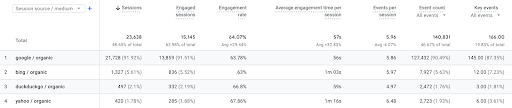
Below is an example of a couple of clients’ traffic. Obviously, the lion’s share of organic traffic (91%) and contact form conversions (90%) is from Google. The conversion rate of that traffic is .66% Now, we look at Bing, DuckDuckGo and Yahoo and we see much smaller volume. However, we see better conversion rates at .93%. That’s almost 50% better, with a much smaller sample size. Yahoo users also spend 30% more time on the site.
Here is another client. Google accounts for 86% of their organic leads and 83% of their form fills. The overall conversion rate from Google is 6.3%. The conversion rate from the other three combined is 8.2%, a 33% increase. DuckDuckGo and Bing users spend 25% more time on the site.
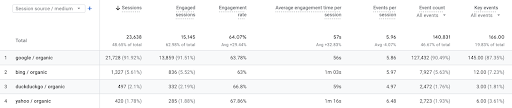
If these secondary channels are driving leads organically—even just a handful—it proves that your audience is there. Not all websites will see this type of success on those channels. But when you do see success like this, it may be time to consider folding Microsoft Advertising (formerly Bing Ads) campaigns into your ad mix (if you’re already running Google).
Why Microsoft Advertising Wins on ROI
Microsoft Advertising distributes ads across Bing, Yahoo, and DuckDuckGo simultaneously. Because most of the world is fighting for keywords on Google, the auction on Microsoft Advertising is far less competitive.
We regularly see Cost-Per-Click (CPC) on Bing that is 30% to 60% cheaper than the exact same keywords on Google Ads.
Think about that math. If you are paying $20 per click on Google for a competitive term like “Managed IT Services,” you might pay $8 for that same click on Bing. And remember, that visitor is likely on a corporate device with a higher intent to purchase.
We have seen clients who were struggling to break even on Google Ads move a portion of their budget to Bing and see their Cost-Per-Acquisition (CPA) drop by half.
The “AIO” Factor
There is another reason to diversify right now. As I mentioned earlier, Google is aggressively rolling out AI Overviews (AIO). These are the AI-generated summaries that appear at the very top of the search results, often pushing the classic “10 blue links” below the fold.
When an AIO appears, the click-through rate to organic results drops significantly. Google is trying to answer the user’s question on Google, rather than sending them to you.
While Bing has its own AI integration (Copilot), the traditional search interface on Bing and DuckDuckGo remains more navigable for organic clicks in many queries. By maintaining a presence on these engines, you are hedging your bets against Google’s zero-click future.
Don’t Leave Money on the Table
Marketing is about being where your customers are, not just where the crowds are.
If you are running a robust digital marketing strategy, you should absolutely be optimizing for Google. It’s still the king. However, you should be watching your alternate search engine traffic and AI-referral traffic from ChatGPT, Gemini, Co-Pilot, Claude, and Perplexity. But you cannot afford to have a blind spot for other channels in your market—especially when they also have decision and purchasing power.
Check your analytics today. Filter your traffic by “Source/Medium.” If you see Bing, Yahoo, or DuckDuckGo on that list, you have a validated lead source that you are currently under-utilizing.
It might be time to pay a little respect to the Princes.
If you aren’t sure how to read your data or want to see if Microsoft Advertising would work for your business, let’s look at the numbers together. You can reach me directly at Jeff@KWSMDigital.com or contact us through our website to start the conversation.